
Keeping Grade School Children Safe in Vehicles
Learn How Parents Can Empower Children to Prioritize Safety
Why the Right Restraint Matters for Children Ages 6–12
Choosing the right car seat or booster and teaching children to buckle up correctly helps protect them during every ride and sets the foundation for a lifetime of safe choices. As children ages 6–12 grow more independent, it’s the perfect time to involve them in understanding how and where they ride safely in a vehicle. By choosing the right car seat or booster together — and modeling safe habits — parents can empower children to take ownership of their safety and build lifelong skills.
How Safety Advocates Support Families
Safety advocates empower children to take part in their own safety by teaching them to check seat belt fit and speak up, building confidence and lifelong habits.
Empowering School Aged Children Through Education

- Using age-appropriate materials to teach children how to buckle up and understand why safety matters helps them follow rules — even when parents aren’t around.
- Model and promote safe behaviors in schools, community events, and healthcare settings.
- Provide trusted resources and tools to help parents assess when a child is ready to transition from one stage to the next.
- Share trusted resources like the Centers for Disease Control and Prevention Booster Seat Guide to check seat belt fit and review booster seat guidelines.
- Encourage regular fit checks as children grow. Use the Johns Hopkins Booster Seat Fit Guide to assess readiness.
- Promote policies and programs that support child passenger safety education. Example: American Academy of Pediatrics | Child Passenger Safety.
Sharpen Your Skills
-
According to the National Highway Traffic Safety Administration and the Centers for Disease Control and Prevention, a child should remain in a forward-facing car seat with a harness and
tether until they reach the maximum height or weight limit allowed by the car seat manufacturer. - The longer a child can safely remain in a forward-facing seat with a harness, the better protected they are in the event of a crash.
- Once the child outgrows the forward-facing seat with a harness, they should move to a booster seat, still in the back seat.
- Educate caregivers on the importance of proper restraint systems, including booster seats and seat belt fit.
- Take the Booster Seats and Seat Belts Mini Course. The-is free online learning takes about 30 minutes to complete. To train your staff and track course completions, group delivery options are available upon request.
Booster Seats: A Critical Step for Growing Children
- Children ages 6–12 may seem big enough for adult seat belts, but many still need booster seats to ensure the seat belt fits properly. Adult seat belts are designed for grown-ups, and a poor fit can lead to serious injuries in a crash. Signs Your Child Still Needs a Booster:
- The seat belt rides up on the stomach or across the neck.
- Knees don’t bend comfortably at the seat’s edge.
- They slouch or shift to get comfortable.
If any of these apply, your child likely still needs a booster seat. Remember: seat belt readiness depends on proper fit — not age or size alone.
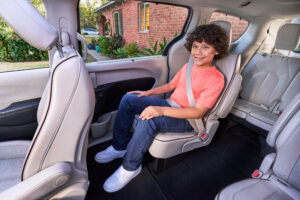
Booster Seats Bridge the Gap
- Children ages 6–12 often still need booster seats to ensure adult seat belts fit properly. Poor seat belt fit can lead to serious injuries in a crash.
- Fit Over Age – Seat belt readiness depends on fit, not age or size.
- Use the Johns Hopkins All Children’s Booster Seat Safety fit test to determine if your child is ready to ride without a booster.
Model Safe Behavior
- Children learn by watching adults. Always buckle up and use proper restraints.
- Talk about why safety matters — not just rules, but real-life protection.
- Make booster seat use a family standard, not a personal choice.
Common Mistakes to Avoid
- Moving out of a booster seat too early.
- Letting children ride with the shoulder belt behind their back or under their arm.
- Assuming a child is safe in the front seat — back seat is safest until age 13.
School Safety Tips

Safety for Every Ride
- Do regular seat belt fit checks as your child grows.
- Keep car seats and booster seats in all vehicles your child rides in — not just the family car.
- Even short trips can be dangerous. Reinforcing safe habits every time helps children understand the importance of buckling up and staying safe.
- Buckle up every time — no exceptions.
- Make sure the seat belt is snug and properly positioned across the thighs and collarbone.
- Use a booster seat until your child passes the Johns Hopkins fit test.
- Encourage children to speak up if a seat belt feels uncomfortable or doesn’t fit right.
- Share trusted resources like the Centers for Disease Control and Prevention Booster Seat Guide to check seat belt fit and review booster seat guidelines.
- Encourage regular fit checks as children grow. Use the Johns Hopkins Booster Seat Fit Guide to assess readiness.
- Promote policies and programs that support child passenger safety education. Example: American Academy of Pediatrics | Child Passenger Safety.